Original research | Dataset collected on October 25, 2026 | Sample: 1,000,000 domains
How many domains actually have a Domain Rating of 100? Is DR 90 exceptionally rare, or merely uncommon? And what does the distribution look like when I move beyond individual websites and measure one million domains with the strongest backlink profiles in Ahrefs' index together?
On October 25, 2026, I downloaded the complete Top 1 Million ranking made available through the public Ahrefs API and counted every domain by its Domain Rating (DR). The result is a reproducible snapshot of the high-DR end of Ahrefs' index: 3 domains at DR 100, 30 domains at DR 96–100, and 2,044 domains at DR 90–100. At the bottom of the downloaded list, DR 46 is only partially represented because the dataset stops at rank 1,000,000.
Why this dataset became available in 2026
Ahrefs introduced the Top domains by Domain Rating API endpoint on July 31, 2026. This date is documented in the official Ahrefs API changelog. The endpoint delivers the top one million domains in rank order, reporting each domain's rank and its current Domain Rating. According to the current endpoint documentation, requests are free, although an API v3 key is required. Each request can return up to 250,000 records.
Domain Rating is Ahrefs' relative measure of the strength of a domain's backlink profile on a logarithmic, 0–100 scale. It is not a Google metric, an official search-ranking score, a traffic measurement, or an assessment of the trustworthiness or quality of a website. Ahrefs explains its methodology in What is Domain Rating?.
Before preparing this article, I searched for an earlier public study calculating a complete, integer-by-integer DR distribution from this particular newly opened Top 1M API dataset. I could not locate a directly comparable published breakdown. That search result does not prove no one has ever performed similar research; it means I found no verifiable earlier public equivalent in the searches conducted.
How I collected and analyzed one million domains
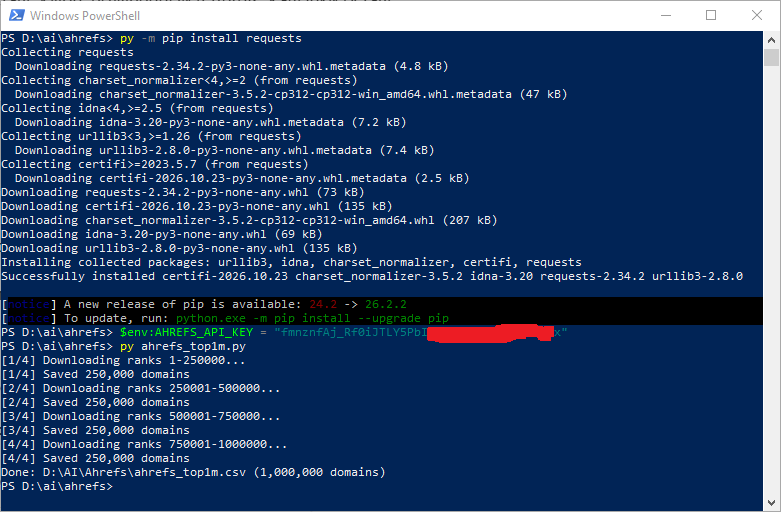
I used the official Ahrefs API rather than scraping search results or estimating scores. My first Python script, ahrefs_top1m.py, queried GET /v3/public/domain-rating-top-domains four times with these inclusive rank ranges: 1–250,000; 250,001–500,000; 500,001–750,000; and 750,001–1,000,000. The script checked record counts and rank order, wrote four intermediate CSV files, and merged them into ahrefs_top1m.csv.
The completed CSV contains 1,000,000 domain records and occupies approximately 27 MB on disk in my download. Each record includes rank, domain, and domain_rating. The Python standard library plus the requests package was sufficient; no paid data export or database server was needed.
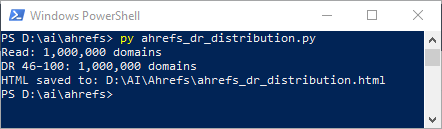
My second script, ahrefs_dr_distribution.py, read that CSV locally and counted records for every integer DR level from 100 down to 46. Fractional values were assigned to their integer floor: for example, DR 79.9 belongs to the DR 79 bucket, not DR 80. I then calculated the share of the million-domain sample, a second share using an external 412-million-domain reference population, and the signed difference against the next lower DR row. A sum check confirmed that all 1,000,000 downloaded records were included in the table.
How to reproduce the results yourself
You can download both Python scripts together from the research scripts ZIP archive. To obtain a free Ahrefs API v3 key, follow the official API key creation instructions and open Account settings → API keys. Ahrefs notes that workspace owners or administrators manage these keys. Keep your key private.
On Windows, open PowerShell in a folder containing both scripts (my example uses D:\ai\ahrefs) and run:
py -m pip install requests
$env:AHREFS_API_KEY = "YOUR_API_KEY"
py ahrefs_top1m.py
py ahrefs_dr_distribution.py
The first script downloads the dataset and writes ahrefs_top1m.csv. The second script performs the offline counting and creates ahrefs_dr_distribution.html. To refresh the table later, run the second command again against the existing CSV; to download a new snapshot, rerun the first script after accounting for its saved chunk cache. The results may differ as Ahrefs updates its index and scores.
The actual Domain Rating distribution: DR 100 to DR 46
The table below contains all 55 integer DR buckets appearing in the downloaded one-million-domain sample, in descending order. The final column is the difference between the current DR bucket and the next lower bucket. A plus means the current bucket contains more domains, and a minus means it contains fewer. This is a cross-sectional comparison between rating categories, not growth or decline over time.
| DR | Number of Domains | % of Top 1M | % of Estimated 412M | Change vs. Next Lower DR |
|---|---|---|---|---|
| 100 | 3 | 0.0003% | 0.00000073% | +1 (+50.00%) |
| 99 | 2 | 0.0002% | 0.00000049% | −1 (−33.33%) |
| 98 | 3 | 0.0003% | 0.00000073% | −9 (−75.00%) |
| 97 | 12 | 0.0012% | 0.00000291% | +2 (+20.00%) |
| 96 | 10 | 0.0010% | 0.00000243% | −11 (−52.38%) |
| 95 | 21 | 0.0021% | 0.00000510% | −55 (−72.37%) |
| 94 | 76 | 0.0076% | 0.00001845% | −60 (−44.12%) |
| 93 | 136 | 0.0136% | 0.00003301% | −183 (−57.37%) |
| 92 | 319 | 0.0319% | 0.00007743% | −390 (−55.01%) |
| 91 | 709 | 0.0709% | 0.00017209% | −44 (−5.84%) |
| 90 | 753 | 0.0753% | 0.00018277% | +257 (+51.81%) |
| 89 | 496 | 0.0496% | 0.00012039% | −55 (−9.98%) |
| 88 | 551 | 0.0551% | 0.00013374% | −172 (−23.79%) |
| 87 | 723 | 0.0723% | 0.00017549% | −146 (−16.80%) |
| 86 | 869 | 0.0869% | 0.00021092% | −172 (−16.52%) |
| 85 | 1,041 | 0.1041% | 0.00025267% | −200 (−16.12%) |
| 84 | 1,241 | 0.1241% | 0.00030121% | −359 (−22.44%) |
| 83 | 1,600 | 0.1600% | 0.00038835% | −252 (−13.61%) |
| 82 | 1,852 | 0.1852% | 0.00044951% | −491 (−20.96%) |
| 81 | 2,343 | 0.2343% | 0.00056869% | −580 (−19.84%) |
| 80 | 2,923 | 0.2923% | 0.00070947% | −581 (−16.58%) |
| 79 | 3,504 | 0.3504% | 0.00085049% | −841 (−19.36%) |
| 78 | 4,345 | 0.4345% | 0.00105461% | −953 (−17.99%) |
| 77 | 5,298 | 0.5298% | 0.00128592% | −1,680 (−24.08%) |
| 76 | 6,978 | 0.6978% | 0.00169369% | −1,465 (−17.35%) |
| 75 | 8,443 | 0.8443% | 0.00204927% | −2,766 (−24.68%) |
| 74 | 11,209 | 1.1209% | 0.00272063% | −1,982 (−15.03%) |
| 73 | 13,191 | 1.3191% | 0.00320170% | −3,984 (−23.20%) |
| 72 | 17,175 | 1.7175% | 0.00416869% | −3,571 (−17.21%) |
| 71 | 20,746 | 2.0746% | 0.00503544% | +3,628 (+21.19%) |
| 70 | 17,118 | 1.7118% | 0.00415485% | +6,089 (+55.21%) |
| 69 | 11,029 | 1.1029% | 0.00267694% | −1,887 (−14.61%) |
| 68 | 12,916 | 1.2916% | 0.00313495% | −456 (−3.41%) |
| 67 | 13,372 | 1.3372% | 0.00324563% | −1,023 (−7.11%) |
| 66 | 14,395 | 1.4395% | 0.00349393% | −1,947 (−11.91%) |
| 65 | 16,342 | 1.6342% | 0.00396650% | −1,374 (−7.76%) |
| 64 | 17,716 | 1.7716% | 0.00430000% | −2,303 (−11.50%) |
| 63 | 20,019 | 2.0019% | 0.00485898% | −1,590 (−7.36%) |
| 62 | 21,609 | 2.1609% | 0.00524490% | −2,845 (−11.63%) |
| 61 | 24,454 | 2.4454% | 0.00593544% | −1,445 (−5.58%) |
| 60 | 25,899 | 2.5899% | 0.00628617% | −2,248 (−7.99%) |
| 59 | 28,147 | 2.8147% | 0.00683180% | −3,581 (−11.29%) |
| 58 | 31,728 | 3.1728% | 0.00770097% | −1,596 (−4.79%) |
| 57 | 33,324 | 3.3324% | 0.00808835% | −3,954 (−10.61%) |
| 56 | 37,278 | 3.7278% | 0.00904806% | −5,241 (−12.33%) |
| 55 | 42,519 | 4.2519% | 0.01032015% | −2,965 (−6.52%) |
| 54 | 45,484 | 4.5484% | 0.01103981% | −7,722 (−14.51%) |
| 53 | 53,206 | 5.3206% | 0.01291408% | −11,818 (−18.17%) |
| 52 | 65,024 | 6.5024% | 0.01578252% | −12,448 (−16.07%) |
| 51 | 77,472 | 7.7472% | 0.01880388% | +13,515 (+21.13%) |
| 50 | 63,957 | 6.3957% | 0.01552354% | +8,607 (+15.55%) |
| 49 | 55,350 | 5.5350% | 0.01343447% | −4,824 (−8.02%) |
| 48 | 60,174 | 6.0174% | 0.01460534% | −5,552 (−8.45%) |
| 47 | 65,726 | 6.5726% | 0.01595291% | +26,556 (+67.80%) |
| 46 | 39,170 | 3.9170% | 0.00950728% | — |
| Total (DR 46–100) | 1,000,000 | 100.0000% | 0.24271845% | — |
What the numbers reveal
The very top is extraordinarily small. Only three domains in the sample have DR 100. All five buckets from DR 96 through DR 100 contain just 30 domains combined, or 0.0030% of the million. Even DR 90–100 accounts for only 2,044 domains (0.2044%). These counts explain why a truly exceptional DR belongs to a narrow group, even within a ranking deliberately restricted to the strongest backlink profiles.
The population becomes much broader below DR 80. There are 15,683 domains with DR 80–100 (1.5683% of the sample), 123,690 with DR 70–100 (12.3690%), and 301,441 with DR 60–100 (30.1441%). Counting DR 50–100 reaches 779,580 domains, or 77.9580% of the entire sample.
The distribution is not perfectly smooth. DR 71 has 20,746 domains, compared with 17,118 at DR 70; DR 51 has 77,472, compared with 63,957 at DR 50. Individual integer buckets can have peaks and dips even though high-level DR is logarithmic. These bumps are visible observations in this single snapshot, not evidence of a particular Ahrefs algorithm change or of artificial score manipulation.
A key limitation concerns DR 46. The sample stops at exactly the millionth-ranked domain, and its last recorded DR bucket is 46. The 39,170 domains shown for DR 46 are only those that fit before the rank cutoff. Additional DR-46 domains can exist beyond rank 1,000,000, but they are not supplied by this endpoint. The 46 row must therefore not be interpreted as the complete number of DR-46 domains in Ahrefs. In particular, the apparent +26,556 (+67.80%) jump from DR 46 to DR 47 is an artifact of comparing an incomplete cutoff bucket with a higher bucket. It should not be used as a substantive trend.
By the way, as of the date of this research, I personally own three domains included in Ahrefs' Top 1 Million ranking. I'm not ready to disclose their names just yet. The highest-ranked of them has a DR of 72 and holds a position in the 85,000–85,999 range in the Ahrefs Rank (AR).
Which domains have DR 96, 97, 98, 99 and 100?
Here are the 30 domains at DR 96–100 in my October 25 snapshot. Within each group, names retain the order in which they appeared in the downloaded Ahrefs ranking.
| DR | Domains | Ranked domains (in order) |
|---|---|---|
| 100 | 3 | facebook.com, instagram.com, google.com |
| 99 | 2 | youtube.com, linkedin.com |
| 98 | 3 | twitter.com, whatsapp.com, wa.me |
| 97 | 12 | wordpress.org, goo.gl, apple.com, tiktok.com, x.com, gravatar.com, github.com, wikipedia.org, t.me, europa.eu, youtu.be, pinterest.com |
| 96 | 10 | shopify.com, microsoft.com, miit.gov.cn, amazon.com, mozilla.org, vimeo.com, squarespace.com, wordpress.com, spotify.com, line.me |
At DR 100, the ranking consists of facebook.com, instagram.com, and google.com. DR 99 contains youtube.com and linkedin.com. Note that this is an Ahrefs backlink-strength ranking on the collection date, not a list of the most-visited domains and not a permanent ordering.
Why compare one million domains with 412 million?
The table's fourth column uses 412,000,000 registered domains as an external scale reference. It is a rounded form of a measured figure: in its October 22, 2026 announcement, Verisign reported 411.6 million domain name registrations worldwide at the end of the third quarter of 2026 (September 30). This represents registrations across all top-level domains, rather than unique active websites or domains indexed by Ahrefs.
The calculation is deliberately simple: (number of domains in this DR row / 412,000,000) × 100. On this reference scale, the entire one-million-domain download equals approximately 0.24271845% of worldwide domain registrations. For example, the 3 DR-100 domains represent about 0.00000073% of the rounded 412-million total.
However, this column does not estimate the percentage of all registered domains that have a particular DR. My sample of one million domains is a top-ranked, non-random subset; the hundreds of millions outside the sample may have lower ratings, may be missing from Ahrefs' database, or may not correspond to active websites. I use the 412-million figure only to put very small counts into global perspective, not to extrapolate the Ahrefs DR distribution to the whole internet.
What this study can and cannot establish
It can establish the exact observed bucket counts in the downloaded file, the rarity of the upper DR bands within the top million, and the reproducible relationship between Ahrefs' rank positions and integer DR categories on October 25, 2026. It cannot establish the complete global distribution of DR across all domains, prove a causal relationship between DR and organic search traffic, or show how counts have changed historically. Doing that would require a broader sampling strategy or repeated snapshots over time.
For domain researchers, publishers, and backlink analysts, the practical lesson is that a DR value needs context. DR 90 sits in a very different part of this ranking from DR 70 or DR 50, but the number alone does not explain why a domain acquired its links, whether those links are useful, or whether the website merits trust.
Next: the same million domains by TLD and domain level
This is the first article in my Ahrefs Top 1M research series. In the next article, I will break down the same one-million-domain dataset by top-level domain (TLD) — including extensions such as .com, .org, and country-code TLDs — and by domain depth: second-level names, third-level names, and deeper hostnames. I will distinguish simple label counts from effective registrable-domain levels, an important detail for suffixes such as .co.uk and for public hosting platforms.
Comments (0)