On November 5, 2026, Ahrefs announced the fourth version of its Domain Rating metric. The new model, officially called DR4, is scheduled to replace the current DR3 in the Ahrefs interface on December 1, 2026.
However, there's no need to wait until December. DR4 scores are already available through the free Ahrefs API.
This is not just a minor recalculation. Ahrefs is changing which websites can influence Domain Rating, introducing independent ratings for subdomains, and significantly reducing the scores of websites associated with link spam.
As someone who maintains a website directory and regularly works with SEO metrics, I find this update particularly interesting. The announcement also contains a few clues about how the new algorithm might work, even though Ahrefs hasn't published its exact formula.
What Is Changing in DR4?
Domain Rating measures the relative strength of a website's backlink profile on a logarithmic scale from 0 to 100. It is an Ahrefs metric, not a Google ranking factor.
Under DR3, the calculation largely depends on the strength of referring domains, how many unique domains they link to, and the distribution of link equity across the network.
DR4 remains a backlink-based metric, but introduces several important changes.
1. A Much Smaller Pool of Influential Websites
According to Ahrefs, approximately half as many websites receive a DR4 rating as receive a DR3 rating.
The company explains that links from websites and individual subdomains with estimated organic search traffic now receive greater weight.
This is perhaps the most interesting change. Previously, a website could accumulate a relatively strong DR despite having little or no meaningful presence in Google's organic search results.
Under DR4, such backlinks may carry considerably less influence.
2. Subdomains Are Evaluated Independently
Until now, many subdomains inherited the Domain Rating of their parent domain.
A small website hosted on a popular platform could therefore display an impressive rating without having an equally impressive backlink profile of its own.
DR4 addresses this problem by assigning separate scores to individual hosts.
Some examples published by Ahrefs:
| Subdomain | DR3 | DR4 |
|---|---|---|
| help.ahrefs.com | 91 | 75 |
| play.google.com | 100 | 96 |
| blogs.microsoft.com | 96 | 87 |
| insights.samsung.com | 92 | 73 |
The difference can be much more dramatic for small websites hosted on shared publishing platforms.
Ahrefs even provides examples of subdomains falling from DR 92 to values close to zero.
This change should make Domain Rating more useful when evaluating backlinks from hosted blogs, free website builders, and similar services.
3. Spam-Related Ratings Are Being Reduced
Ahrefs reports that domains marked as spam with previous DR3 scores between 30 and 70 experienced median decreases of approximately 15–20 points.
In contrast, websites not classified as spam generally experienced much smaller changes.
This suggests that DR4 is designed to be considerably less vulnerable to artificially inflated backlink profiles.
It's worth mentioning that Ahrefs introduced machine-learning-based spam detection in January 2026, replacing an earlier manually curated system.
The relationship between that classifier and the new DR calculation is especially interesting.
What Might the New DR4 Formula Look Like?
Ahrefs has not disclosed the mathematical formula behind DR4. However, the announcement provides enough information to make several reasonable hypotheses.
These are my interpretations, not confirmed details of the algorithm.
Organic Traffic as a Quality Signal
The biggest clue is the statement that links from websites with estimated organic search traffic now receive greater weight.
A simplified conceptual model might look something like this:
Link contribution ≈ Source authority × Traffic-based weight × Link distribution factor
The traffic-based weight is hypothetical. Ahrefs has not confirmed that such a multiplier exists or how it would be calculated.
Still, the principle seems plausible.
Imagine two websites with identical DR3 scores and similar numbers of referring domains.
One receives regular organic traffic from Google. The other has almost no organic visibility despite having thousands of backlinks.
Under the new model, the first website might contribute substantially more value to the websites it links to.
Importantly, this does not necessarily mean that traffic directly increases a website's own DR. It may instead influence how much authority a linking website can pass.
That distinction matters.
Independent Link Graphs for Subdomains
The second likely change concerns the underlying link graph.
Previously, many subdomains effectively benefited from the reputation of their parent domains.
DR4 appears to evaluate individual hosts more independently.
For example, a personal project hosted on a popular platform should no longer automatically benefit from the parent platform's enormous backlink profile.
A plausible implementation would treat eligible subdomains as separate nodes when evaluating incoming and outgoing links.
This could also explain why certain large hosting-related domains lose significant rating points while some of their individual subdomains retain strong scores.
The precise handling of links between a root domain and its subdomains remains undisclosed.
Spam Detection May Influence Link Weight
Another reasonable possibility is that Ahrefs now incorporates stronger spam-related adjustments into the rating calculation.
If a linking domain is identified as spam, its contribution could be reduced or excluded entirely.
A conceptual model might therefore include an additional factor:
Link contribution ≈ Source authority × Traffic weight × Spam adjustment ÷ Outgoing link distribution
Again, this is only an illustrative formula, not a reconstruction of Ahrefs' proprietary algorithm.
The exact weighting, normalization, treatment of individual links, and iterative calculations are unknown.
Nevertheless, the combination of traffic-related weighting and spam-related score reductions suggests a deliberate move away from simply rewarding large backlink networks.
A domain with thousands of weak or artificial backlinks may no longer look stronger than a smaller website with a genuinely useful backlink profile.
Does DR4 Correlate Better With Google Rankings?
Ahrefs tested the new model against ranking data for 10 million domains and hosts.
The results are interesting, but they deserve closer examination.
For correlations with the number of top-10 Google ranking positions, Ahrefs reported:
| Website group | DR3 | DR4 |
|---|---|---|
| All hosts | 0.140 | 0.359 |
| Root domains | 0.407 | 0.304 |
| Subdomains | 0.172 | 0.259 |
Across all hosts, DR4 demonstrates a substantially stronger correlation with ranking visibility.
However, there is an important detail: for root domains alone, DR3 actually shows a stronger correlation than DR4.
This is easy to overlook.
The improvement is particularly noticeable when subdomains are included. That makes sense because the older model was primarily designed around root domains.
The new approach may therefore be better suited to comparing different types of websites, rather than automatically outperforming DR3 in every possible scenario.
And correlation is not causation. A higher Domain Rating does not directly improve Google rankings.
Will Your Domain Rating Increase or Decrease?
There is no universal answer.
Among the 1,000 websites with the highest estimated organic traffic in Ahrefs' dataset:
- 64.3% received a higher DR4 score.
- 15.8% remained unchanged.
- 19.9% received a lower score.
Even large, established websites may lose a few points.
For websites with weak backlink profiles, limited organic visibility, or suspicious link patterns, the changes could be more substantial.
It would be a mistake to interpret every decrease as evidence of a website losing quality.
The website itself may not have changed at all. What changed is the scoring system and the relative value assigned to different backlink sources.
For SEO analysis, this creates another practical problem: historical comparisons.
A DR3 value of 45 measured in November and a DR4 value of 32 measured in December are not directly comparable as if they came from the same calculation model.
For research and reporting, keeping both values temporarily is much more useful.
I've Already Added DR3 and DR4 to AI Web Directory
Since Ahrefs has made DR4 available through its API ahead of the official launch, I've already implemented support for both versions in my own project, AI Web Directory.
The directory now displays DRv3 and DRv4 side by side on individual website pages.
This makes it possible to compare the old and new ratings directly without switching between separate tools or waiting until December 1.
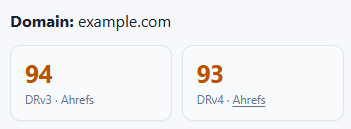
AI Web Directory displays both Ahrefs Domain Rating versions simultaneously, making the differences easy to compare.
The integration uses the Ahrefs Domain Rating API, where the current DR3 is the default and the new model can be requested using the version=dr4 parameter.
From a development perspective, I consider retaining both values important. Overwriting the old rating immediately would destroy a useful point of comparison.
It also creates an opportunity to examine how different categories of websites respond to the new calculation: established projects, smaller websites, subdomains, and domains with limited organic visibility.
The live directory at aiwebdir.com provides a practical way to explore these differences.
Beyond the Numbers
I consider DR4 one of the more meaningful changes to Ahrefs' Domain Rating metric.
The separation of subdomains is a long-overdue improvement. The reduced influence of websites without meaningful organic search visibility could also make the metric more useful for evaluating potential backlink sources.
The most intriguing part, however, is what Ahrefs has not disclosed.
How strongly does estimated organic traffic affect the contribution of a linking domain? How are spam classifications incorporated? And how does the new host-level calculation redistribute authority across the web?
We don't yet know the answers.
My expectation is that DR4 will make certain types of artificially inflated Domain Rating much harder to maintain, although it certainly won't eliminate all possibilities for manipulation.
For now, the most useful approach is to compare both versions rather than treating either number as an absolute measure of website quality.
DR4 becomes the standard Ahrefs rating on December 1, 2026. But the comparison can begin today.
Comments (0)